Showing posts with label AGN. Show all posts
Showing posts with label AGN. Show all posts
Tuesday, September 10, 2019
Wednesday, July 3, 2019
Changing look AGN in the mid-infrared, EWASS2019
Slides of presentation about changing look AGN in the mid-infrared given at the EWASS2019 meeting, Lyon, France, June, 2019
303_SS4c_1745_Asmus by Daniel Asmus on Scribd

Thursday, January 3, 2019
Friday, December 7, 2018
COMING UP: TORUS 2018
The many faces of the AGN obscuration
Puerto Varas, Chile
10-14 December 2018
10-14 December 2018
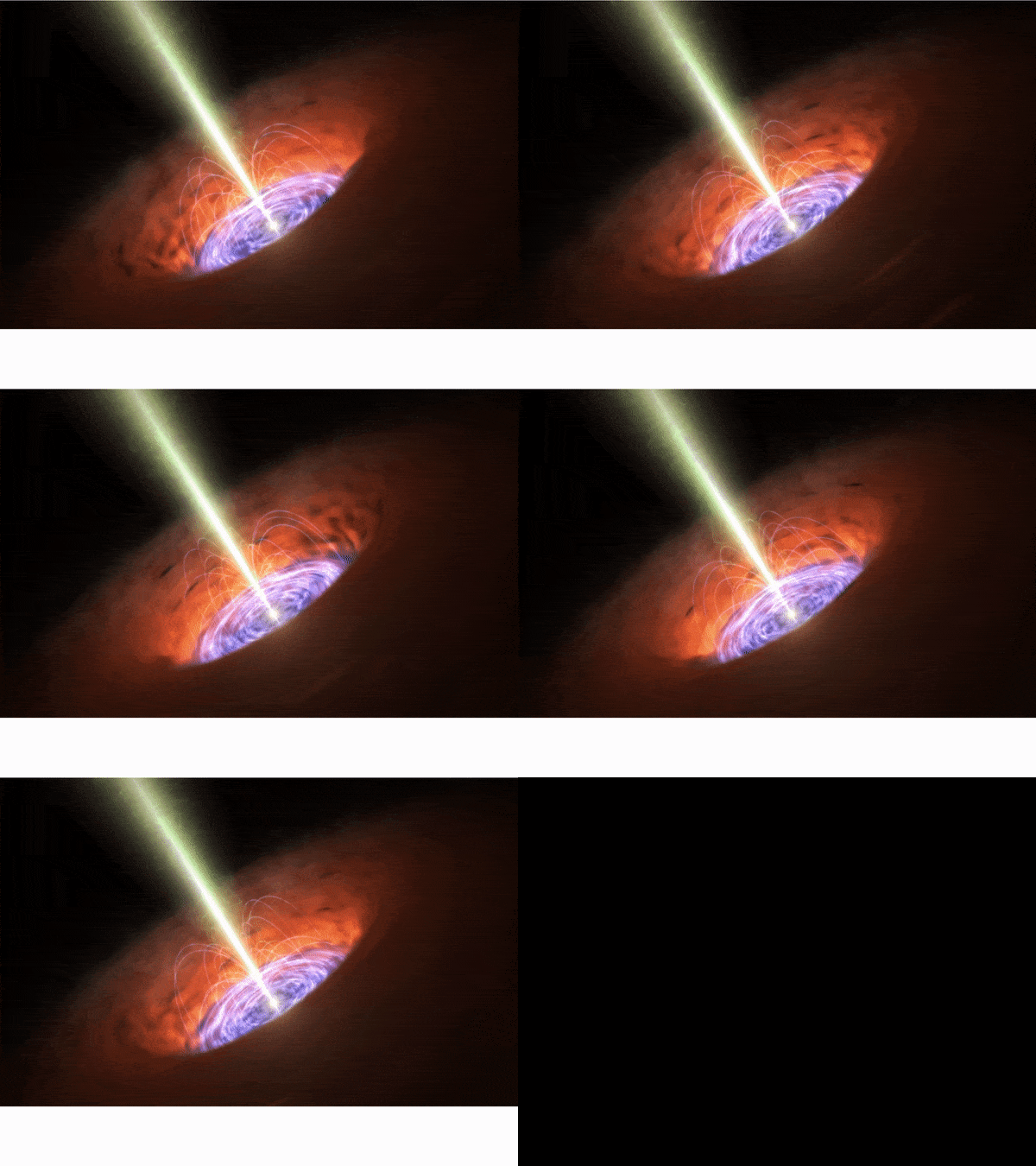 Looking forward to a great programme with a lot of great people, talking about our favourite kind of AGN structure (that actually is not one structure at all ;-))...
Wednesday, November 15, 2017
Resolving the dust structure in active galactic nuclei
Colloquium talk given at the Observatory of Belgrade in 2017 as an overview of high angular resolution imaging of AGN
The nuclei of many galaxies shine bright throughout all the electromagnetic spectrum. This powerful emission if often brighter than all the star light of the galaxy combined. Its source is an accreting supermassive black hole in the galaxy center. However, around half of the accretion disk emission does not escape the nuclear region but is instead absorbed by an unknown dust structure and reemitted in the infrared. I will present an overview of our attempts to detect and resolve this dust structure in nearby active galactic nuclei (AGN) and review the surprising results emerging from recent highest angular resolution observations.
The nuclei of many galaxies shine bright throughout all the electromagnetic spectrum. This powerful emission if often brighter than all the star light of the galaxy combined. Its source is an accreting supermassive black hole in the galaxy center. However, around half of the accretion disk emission does not escape the nuclear region but is instead absorbed by an unknown dust structure and reemitted in the infrared. I will present an overview of our attempts to detect and resolve this dust structure in nearby active galactic nuclei (AGN) and review the surprising results emerging from recent highest angular resolution observations.
Monday, July 4, 2016
The predominance of infrared emission from the polar region of accreting supermassive black holes
Talk given at the AGN conference Garching 2016...
Wednesday, June 22, 2016
Tuesday, April 1, 2014
Finally published: The subarcsecond mid-infrared view of local active galactic nuclei: I. The N- and Q-band imaging atlas
The AGN mid-infrared atlas is finally published!
The full paper including the appendix with all the object descriptions is available on arXiv: http://arxiv.org/abs/1310.2770.
ADS: http://adsabs.harvard.edu/abs/2014MNRAS.439.1648A
The tables can be accessed through CDS: http://cdsarc.u-strasbg.fr/cgi-bin/VizieR?-source=J/MNRAS/439/1648.
The images, fits files, tables and object descriptions can be accessed through the Virtual Observatory via GAVO (Topcat, Aladin etc.; ID: sasmirala). Original front-end: http://dc.g-vo.org/sasmirala.
Direct download of collections:
Please contact me in case of questions or comments! I am happy to give support to anyone who wants to use the data!
The full paper including the appendix with all the object descriptions is available on arXiv: http://arxiv.org/abs/1310.2770.
ADS: http://adsabs.harvard.edu/abs/2014MNRAS.439.1648A
The tables can be accessed through CDS: http://cdsarc.u-strasbg.fr/cgi-bin/VizieR?-source=J/MNRAS/439/1648.
The images, fits files, tables and object descriptions can be accessed through the Virtual Observatory via GAVO (Topcat, Aladin etc.; ID: sasmirala). Original front-end: http://dc.g-vo.org/sasmirala.
Direct download of collections:
- PDF with all object descriptions (Appendix only): http://mnras.oxfordjournals.org/content/suppl/2014/02/17/stu041.DC1/AGN_atlas_MIR_paper_onlineonly.pdf
- All fits files: http://dc.zah.uni-heidelberg.de/sasmirala/q/prod/static/collection/fits.tar.gz
- All tables: http://dc.zah.uni-heidelberg.de/sasmirala/q/prod/static/collection/tables.tar.gz
- All plots: http://dc.zah.uni-heidelberg.de/sasmirala/q/prod/static/collection/plots.tar.gz
Please contact me in case of questions or comments! I am happy to give support to anyone who wants to use the data!
Wednesday, October 2, 2013
The subarcsecond mid-infrared view of local active galactic nuclei: I. The N- and Q-band imaging atlas
Abstract:
This is the submission version of the mid-infrared atlas paper (451 pages, 930 Figures, ~50MB, submitted to MNRAS).
Download: https://www.dropbox.com/s/njug032m3wfsimr/AGN_atlas_MIR_paper_subm.pdf
Comments are welcome!
For the preliminary data tables in CDS format, see https://www.dropbox.com/s/u36i0xjimfhojst/tables.tar.gz .
The final tables and fits images will be available via the German VO (GAVO) and CDS after acceptance.
This is the poster of the IAU Symposium S304: Multiwavelength AGN Surveys and Studies in Armenia (Oct 2013):
We present the first subarcsecond-resolution mid-infrared (MIR) atlas of local active galactic nuclei (AGN) containing 253 objects with a median redshift of z = 0.016. It comprises all available MIR imaging observations performed to date with ground-based 8-meter class telescopes and includes in total 895 independent photometric measurements, of which more than 60% are previously unpublished.We detect extended nuclear emission in at least 21% of the objects, while another 19% appear clearly point-like, and the remaining objects cannot be constrained. Subarcsecond resolution allows us to isolate the emission of the AGN on scales of a few tens of parsecs for the bulk of the sample and obtain nuclear photometry in multiple filters for the objects. The photometry is used to construct median spectral energy distributions (SEDs) for the different optical AGN types and estimate the individual MIR 12 and 18 um continuum luminosities, which range over more than six orders of magnitude. We also analyse the arcsecond-scale MIR emission as probed by Spitzer and compare it to the subarcsecond-scale emission. The continuum emission is on average 20% lower on subarcsecond scales with a large scatter that depends mostly on the object distance or luminosity. The silicate feature strength is similar on both scales and generally appears in emission (absorption) in type I (II) AGN. However, the PAH emission appears weaker or absent on subarcsecond scales, indicating that most of the star formation has been resolved out. The differences of the MIR SEDs on both scales are particularly large for AGN/starburst composites and close-by (and weak) AGN. Because of its size and characteristics, the AGN MIR atlas is well-suited not only for detailed investigation of individual sources but also for sample studies of AGN unification.
This is the submission version of the mid-infrared atlas paper (451 pages, 930 Figures, ~50MB, submitted to MNRAS).
Download: https://www.dropbox.com/s/njug032m3wfsimr/AGN_atlas_MIR_paper_subm.pdf
Comments are welcome!
For the preliminary data tables in CDS format, see https://www.dropbox.com/s/u36i0xjimfhojst/tables.tar.gz .
The final tables and fits images will be available via the German VO (GAVO) and CDS after acceptance.
This is the poster of the IAU Symposium S304: Multiwavelength AGN Surveys and Studies in Armenia (Oct 2013):
Wednesday, January 16, 2013
Tuesday, September 11, 2012
Thursday, July 12, 2012
Talk at EXGAL meeting ESO: The mid-infrared correlation of AGN
Here are the slides of my latest talk at the extragalactic group meeting, ESO, Santiago on July 12th 2012:
Asmus Exgal Short
Asmus Exgal Short
Sunday, July 8, 2012
ESO 30-minute-talk
Here are the slides from the most recent talk that I gave during my stay at ESO in Vitacura, Santiago de Chile on the 28th of June 2012:
Presentation: Daniel Asmus: MId-infrared properties of local active galactic nuclei
Presentation: Daniel Asmus: MId-infrared properties of local active galactic nuclei
My PhD thesis...
is now online accessible and can be found here: http://eldiss.uni-kiel.de/macau/receive/dissertation_diss_00008489
Subscribe to:
Posts (Atom)